
Seasonal Performance Shifts and Returns on Multi-Horse Wagers in British Flat Racing
Seasonal form curves in British flat racing reflect how horses respond to changing ground conditions, daylight hours, and training cycles across spring, summer, and autumn campaigns, while exotic wagers such as exactas, trifectas, and forecasts deliver variable payouts that track these performance patterns on circuits including Newmarket, Ascot, and York. Data from racecourse records shows that early-season runners often post lower win rates on softer spring ground before adapting to firmer summer surfaces, and this progression directly influences the odds compilers set for combination bets.
Understanding Form Curves Through the Racing Calendar
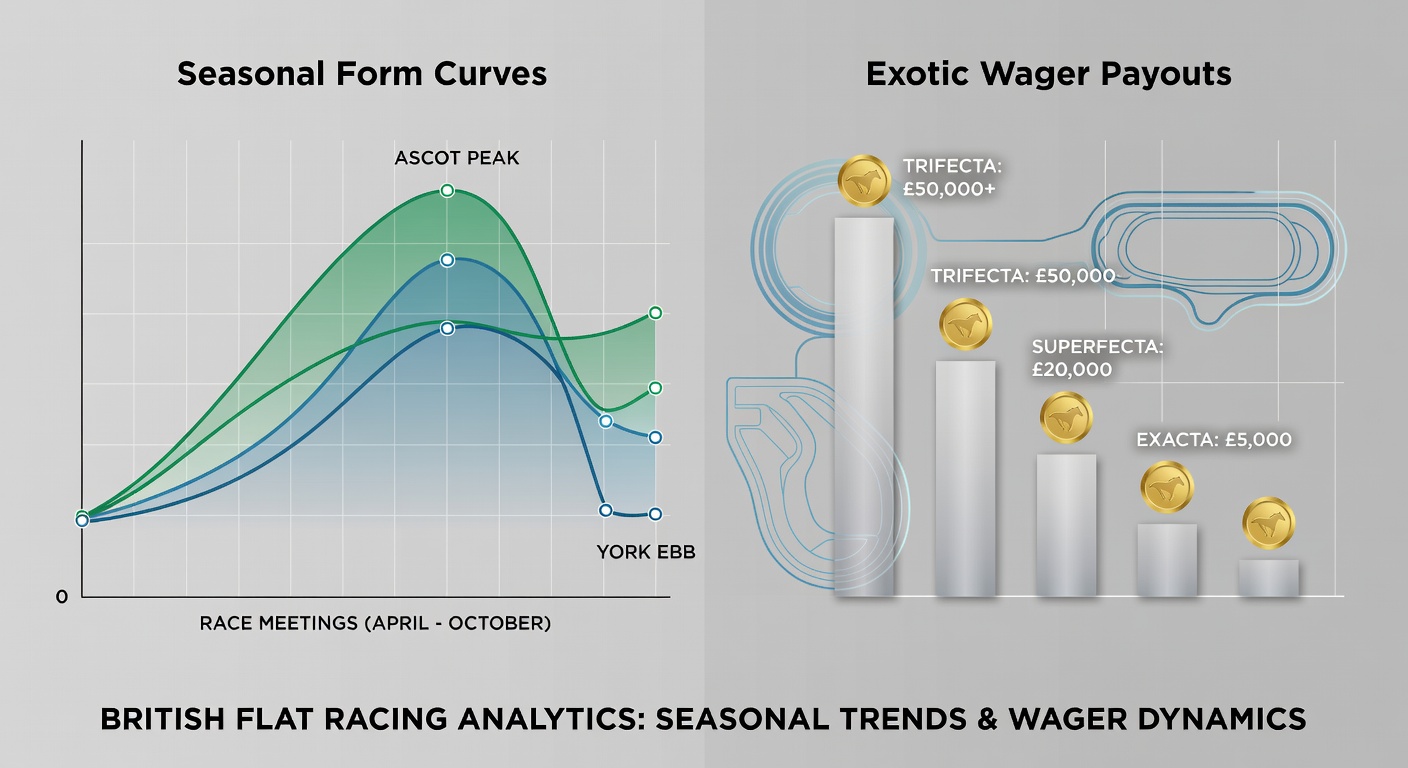
Observers note that horses debuting in March and April frequently carry forward winter preparation that produces inconsistent results until they encounter faster ground in May, yet those same animals can improve markedly once the calendar advances into June events such as Royal Ascot where firmer conditions prevail and pace scenarios stabilise. Research indicates that trainers adjust preparation schedules to align peak fitness with these transitions, which in turn alters the probability distributions that bookmakers apply to exotic markets. For instance, a horse with a strong closing style on good ground might see its place probability in a trifecta rise from 12 percent in April to 28 percent by July once the form curve peaks.
Track surfaces at northern circuits like Haydock and Ripon tend to retain moisture longer into the season compared with southern venues, creating regional variations in form that exotic bettors must factor into selections, and historical results compiled over multiple years reveal that late-summer races on these tracks produce tighter margins among placed horses which compresses payouts on combination wagers. Data shows that average trifecta dividends at York during the Ebor meeting in August run approximately 15 percent lower than equivalent races at Newmarket in April, reflecting both tighter field quality and more predictable form lines once the seasonal curve has flattened.
Exotic Wager Structures and Seasonal Payout Influences
Exotic betting products on British flat circuits combine multiple runners into single wagers, and the payout mechanics respond directly to shifts in form reliability across the season. An exacta bet, which requires the first two finishers in correct order, carries higher volatility in spring meetings where many runners remain unexposed, whereas the same wager type at late-season fixtures benefits from established patterns that reduce the number of viable outcomes. Figures from race analysis firms indicate that the mean exacta return at Doncaster's St Leger meeting in September sits 22 percent below the equivalent average recorded at the Craven meeting in April.
Trifecta and forecast markets follow similar seasonal compression, and those who study payout tables observe that the presence of established Group performers in summer handicaps further narrows the distribution of possible combinations. In June 2026 the Royal meeting at Ascot is expected to feature several leading three-year-olds whose prior runs already establish clear hierarchies, and this clarity typically produces lower exotic dividends than the more open fields encountered earlier in the campaign. Industry reports compiled by the Australian Racing Board have documented comparable seasonal tightening in southern hemisphere equivalents, confirming that form-curve maturation affects multi-leg payouts across racing jurisdictions.
Regional Circuit Differences and Data Patterns
British flat racing circuits display distinct seasonal signatures that exotic bettors monitor through sectional timing and trainer statistics. Southern tracks such as Sandown and Epsom reach peak ground firmness earlier than their northern counterparts, and this accelerates the form curve for horses based in the south while leaving northern-trained runners at a temporary disadvantage until they travel. Records maintained by European turf authorities show that horses shipping from northern stables to southern summer festivals record place rates 8 percent below their home-track averages, a disparity that inflates exotic payouts on cross-regional selections.
What's interesting is how these regional imbalances evolve by late season when ground conditions equalise and the form curve for most horses has stabilised. Punters who track trainer strike rates across circuits discover that certain yards maintain higher exotic success rates once the calendar reaches September, because their runners have completed the necessary adaptation cycle. One study released by teh University of Melbourne's equine research group examined analogous patterns in Australian racing and found that seasonal adaptation periods last between six and nine weeks regardless of hemisphere, providing supporting evidence that British form curves follow predictable biological and environmental timelines.
Practical Implications for Payout Management
Bookmakers adjust exotic odds matrices throughout the season to reflect the narrowing variance in outcomes once form curves mature. Early-season races therefore offer higher theoretical returns on correctly structured combination bets, yet they also carry greater risk of long-priced outliers that can distort dividends in either direction. Late-season meetings, by contrast, produce more consistent but lower payouts because fewer runners remain capable of springing surprises once their seasonal peak has passed. Observers who monitor tote data note that the proportion of exotic pools paid out on favourites rises from 34 percent in April to 51 percent by October across major British circuits.
Those who analyse these trends often combine sectional data with trainer and jockey statistics to identify windows where the form curve remains sufficiently fluid to support higher exotic returns. Such analysis requires attention to both ground conditions and the timing of major targets, because a horse aimed at a September highlight may run below its best in July and thereby create temporary value in multi-horse wagers before the curve realigns.
Conclusion
Seasonal form curves in British flat racing establish clear performance trajectories that directly shape the payout landscape for exotic wagers, and data from multiple circuits demonstrates how spring volatility gives way to summer stability and autumn consolidation. The interaction between ground progression, regional differences, and established hierarchies produces measurable shifts in exacta, trifecta, and forecast returns that remain consistent across seasons. Those who examine the historical record alongside current preparation patterns can identify the periods when these curves create the most pronounced effects on combination betting outcomes.